

How To Clean Concrete Block Retaining Wall
Ballsy retaining wall guide setting out the eleven different materials you can use to build a functional, durable, potent and cute retaining wall also every bit 8 retaining wall designs.

By definition, a retaining wall is a structure that is used for supporting the soil mass laterally, so that the soil on dissimilar sides of the wall is retained at different levels.
Retaining walls are, thus, used to spring ii soils between ii different terrain elevations in situations where possessing slopes would be undesirable. Such situations include building a basement, but the more mutual instances when we use retaining walls are gardening and landscaping.
Of course, although it is very easy to assume that a retaining wall is simply a wall that was built to hold a certain type of soil, things are non equally simple as they seem. For instance, dissimilar normal walls that have lateral back up at the peak, retaining walls don't. Normal walls are built to bear vertical loads while retaining walls are dealing with horizontal loads.
Obviously, this divergence entails different engineering approaches. Different the state of affairs when we want to only separate an empty infinite, the presence of vertical load can be addressed with the use of gravity walls, piling walls, cantilever walls, and anchored walls.
However, in a huge number of situations (gardening) the vertical pressure is not that horrifying, so the ability of the wall to carry the bear of the load is mostly determined by the ability of the build material to deal with this situation.
Therefore, we will take a look at some of the most common build materials and run across how well can they play the role of a retaining wall.
Related:Retaining Wall Ideas | Gabion Wall Ideas | Retaining Wall Alternatives | Lawn Tree Ideas | Backyard Zen Garden Ideas | Lawn Edging Tools
A. eight Retaining Wall Designs (Diagrams)
Below is a series of diagrams showing how to to make strong retaining walls. We set out several structural approaches.
i. Anchored Wall
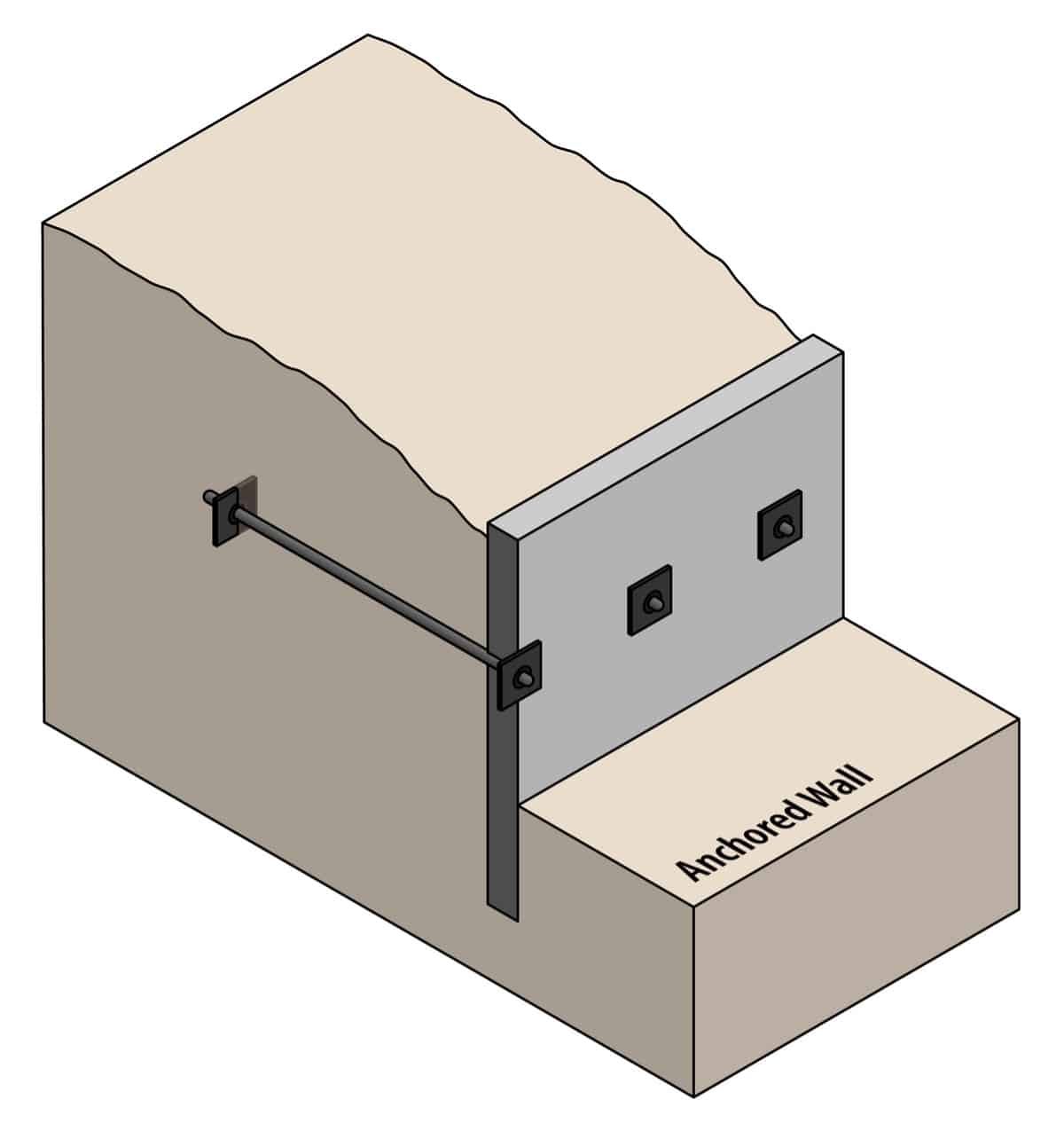
2. Cantilevered "L" Wall

three. Cantilever Wall

4. Counterfort Wall

5. Gravity Wall ane

6. Gravity Wall ii

7. Piling Wall

8. Achored Wall (Screw Design)

B. 10 Retaining Wall Materials
ane. Concrete Blocks

Concrete blocks are a very modern and sophisticated material. Considering it is artificially produced, physical offers a lot of flexibility and diversity to cull from. Also, in spite of the common belief that physical blocks leave a very sterile impression, this material plays extraordinary well with the Spanish architectural style. Physical walls are usually designed to be set on a compacted gravel base of operations and remain stiff fifty-fifty when y'all utilise pressure.
Pros
- Durability – A concrete wall can often terminal upward to a whole century.
- Variety – Concrete blocks come in different shapes and sizes and can exist used to create curves.
- Ease of installation – Concrete block walls are usually much easier to install than some other, more labor-demanding block types.
- Depression maintenance – You can make clean the blocks only one time per year.
- Eco-friendly – Concrete walls are non-toxic and they practice not emit allergens or unsafe chemicals.
Cons
- Architectural demands – Concrete walls accept to be carefully designed, so you lot should ask for a professional person advice about the bug of drainage and effective back up. Also, the lack of proper support may impact durability.
- Lack of height – Concrete block walls can be used only for walls that are no taller than four feet. And so, if you, for instance, want to raise your rose beds to higher levels to protect them from deer, you volition accept to look for another material.
- Complicated to remove – If y'all ever make up one's mind to change the placement of the wall, you will have to undergo a lot of trouble to dismount it.
Toll
Concrete blocks usually have very counterbalanced and uniform prices. Capstones normally toll approximately 95 cents apiece while the average cost of the block is i-3$.
2. Stone veneer

Stone veneer is a protective material that can be used as a decorative covering for vertical walls and surfaces. That means that the veneer itself is a purely aesthetic element and it needs a solid core to even work equally a wall (a role usually played by CMU blocks). Withal, information technology looks stunning (stone veneer but oozes luxury) and brings enough of its ain unique personality to earn a spot on the listing.
Pros
- Durability – The natural stone is a powerhouse build material. Stone structures are capable of withstanding centuries of abuse, and your retaining wall (or at least its façade) will be capable likewise. It volition not fade, and information technology will not crack.
- Look – Natural stone has a very beautiful aesthetics and texture. Beautiful patterns, unique shapes or even the lichen growing on the stone are very difficult to exist emulated by other materials.
- Light weight – Although not amid the lightest materials on the market, stone veneer is reasonably calorie-free. That makes building the wall much easier.
- Flexibility – The solid core tin can exist built in literally whatsoever thickness or elevation.
Cons
- Price – Unlike some other, manufactured materials, natural stone is not that affordable.
- The ease of installation – Installation of stone veneers normally involves the services of a professional contractor.
- Design problems – Matching all the individual pieces with existing architecture is not always easy.
- Solid core – Rock veneer is non a freestanding element, so you volition accept to double the work.
Cost
The price of stone veneer usually varies from $six to $9 per square human foot.
iii. Poured Concrete

Poured, or how people like to call it cast in place concrete is a very popular architectural option produced by pouring the physical directly into the forms on the site. Since it looks very clean-cut and sterile, poured concrete plays along the all-time with the mod-looking surrounding. The power of the concrete to support the soil load depends on conditions conditions and other elements.
Pros
- Strength – Since it features much bigger density than block walls, the walls congenital out of poured concrete are much stronger as a result.
- Variety – Concrete can exist poured in any course you lot can remember of. That gives you a lot of design options to choose from.
- Consequent look – The concrete may await sterile, but at to the lowest degree information technology looks consistent. You always know what you'll become at the end.
- Flexibility – Poured concrete makes incorporating other architectural elements like, for instance, drainage systems very piece of cake.
Cons
- Susceptible to crack – Physical walls unremarkably need some kind of structural support (e.g. steel rods). If they don't, they may crack.
- Building requires a lot of skill – The forms you are going to pour concrete in must be immaculate and perfectly ready. The required skill makes it very difficult residential project.
- Moisture –When exposed to excessive amounts of water, concrete tends to become unacceptably clammy. That may damage surface treatments such as paint.
- Vulnerability to chemical damage – Concrete tin can be hands damaged past a number of chemicals like chlorides, sulfates, and even distilled h2o.
Price
Estimating the cost of the poured concrete is not that easy because you have to take into account the costs of concrete forms, sub-base preparation, reinforcements, and finishing. Nonetheless, nosotros can say that, on average, the price per foursquare foot varies between $iii.25 and $5.25, or $93 per cubic m.
four. Brick

Brick is i of the most popular building materials, and it is very easy to see the appeal. First, in contrast to physical, and even rock, bricks feature a very warm and inviting look. They do a wonderful chore complementing traditional homes and landscapes. But, the expect can push button some building material just so far. Bricks have a lot of other skillful things working for them also.
Pros
- Low maintenance – Brick is a relatively low-maintenance edifice material. Also, it retains color rather well then you won't have to bother with painting for too often.
- Eco-friendly – Bricks are made out of some of the most arable and eco-friendliest materials in the world – shale, and clay. Too, bricks can exist later repurposed for other landscaping projects like walking paths.
- Weather and fire resistance – Bricks are playing extremely well with the elements. They are non damaged by dampness, and they can withstand a lot of abuse acquired by flying droppings. Too, bricks are not combustible and don't assist the spread of fire.
- Durability – A solid, well-made brick is as durable as you can wish for. Nowhere well-nigh every bit durable as stone, merely durable withal.
Cons
- Price – Bricks befall into the upper price segment of outdoor building materials.
- Colour limitations – Although they come in a range of different colors, compared to another materials, bricks do not offer the same degree of variety.
- Heavy – Bricks are quite heavy material. You lot have to pay attending to make your retaining wall a solid foundation.
- The lack of flexibility – Irresolute the outer appearance is problematic, but nowhere near as problematic as replacing a damaged brick.
Toll
A brick with a selling price of $340 will cost y'all $1.96 per square pes. A brick costing $500 per m will require that you pay $two.88 per square pes.
v. Wood

Forest shares a lot of same qualities equally bricks. Both these materials have been with the states forever, they both lend the space they occupy a sense of nostalgia and warmth and they are both made out of widely accessible materials. All the same, when information technology comes to their building material backdrop, they couldn't be further from each other.
Pros
- Natural look – Wooden walls have a tendency to blend into the landscape quite seamlessly.
- Cost – Wooden retaining walls are ordinarily very cost effective.
- Ease of installation – Wooden retaining walls are very easy to install which makes them an ideal DIY landscaping project.
- Lightweight – Although reasonably durable, wood is a very lightweight material that is easy to dismantle, motility around and repurpose.
Cons
- Limited lifespan– Out of all materials on the listing, wood probably has the shortest lifespan. Yet, with the proper maintenance, you lot volition be able to squeeze adept 20 years of service out of it.
- Woods rots – With the proper handling this unfortunate consequence can be postponed but non avoided. If yous are living in an area that sees a lot of rain, you should probably skip this textile.
- Strength – Although they can handle retaining walls nether the top of iv feet, wooden planks are non recommended for some more circuitous projects. They tin protect your plants from the smaller breeds of rabbits, only they won't cut it when it comes to bigger and agiler pests.
- Susceptible to termites – If you don't pay enough attention these small pests can ruin your installation.
Toll
Forest retaining walls usually start $15 per square foot.
6. Boulders

Boulder walls are, without any dubiousness, 1 of the oldest and the best lasting kinds of homo-produced structures. Unlike quarried stone or manufactured modular blocks, boulders are widely available and ready to go even without whatsoever boosted refining. At the aforementioned time, they retain most of the positive aspects of the furnished stones and can concluding you a century (at least). Stone boulders are a perfect fit for any kind of country, colonial, or English-manner garden.
Pros
- Natural await – Boulders are a great lucifer for any kind of rustic dwelling house or landscaping pattern.
- Ease of use – Boulder walls are extremely convenient to build. Some of the projects can be easily accomplished but past stacking the boulders on peak of each other. Building the wall doesn't involve expensive equipment.
- Availability – Boulders of all colors and sizes are extremely easy to obtain and at a very affordable price.
- Durability – Every bit we already mentioned, boulder constructions are in use since the beginning of humanity. Some of them are withal live and well. That should serve as an enough of a testament to boulders' durability.
Cons
- Size – Boulders tend to be quite large. And then, if you own a smaller yard, you should probably skip them – they will eat you a lot of space.
- The lack of flexibility – Boulders are what they are – at that place is very few interventions you tin brand on them. Therefore, they tin be used for the most basic tasks (elevating a section of soil), but not so much for some of the more complex projects (controlling the water flow).
- Transportation – If the blocks are not locally bachelor, transportation can fire you a lot of money.
- Pinnacle – Boulder walls tin can't be built as loftier as concrete walls.
Toll
Due to their uneven size, transportation costs and a wide variety of available types determining the price of the boulders is not that easy. Withal, it is safe to say that they tin can be obtained in the cost range between $100 and $600 per ton.
vii. Gabion

Gabion is a very old method of building the walls. The very name is derived from the Italian world gabbia which stand for cage. And that pretty much describes the gabion walls – they are unproblematic cages fabricated out of wire or steel rods and usually filled with rock or rubble. Although they had the widest application in the times of state of war (during the Civil War, gabion walls were built to protect the soldiers), their power to play forth with almost whatever kind of recycled material (east.g. crushed physical) earned them a very loyal following amongst the modern eco-aware audition.
See our gabion wall and fence article and gallery here.
Pros
- Heavy ground – Gabion walls volition stay firmly in the position even in the case of the worst downpours you tin imagine.
- Flexibility – The baskets and the very materials within them are very flexible and extremely like shooting fish in a barrel to fit in any kind of backyard setup.
- Upgradability – Gabion walls are modular. Thar mean that each of their sections can be easily replaced or upgraded. Too, the gaps between rock or concrete pieces tin be filled with vegetation and silt which should further reinforce the wall.
- Ease of use – Gabion walls can be built fifty-fifty with the slightest noesis of masonry or architecture. The build times are very brusque and the transportation is extremely easy to handle.
Cons
- Visual appeal – Although they can play along with a wide variety of coastal and riverside homes, gabion walls are not that visually pleasing.
- Prone to rust – If you don't put enough care into maintenance, wire baskets can hands rust away, and render the whole setup worthless.
- Vulnerable to water – Exposure to water can impairment the handbasket and cause the corrosion of internal elements (depending on the elements).
Toll
A regular gabion wall commonly costs $35 per cubic thousand (and that would be a three-feet square cage).
8. Timber

Although they, at least on the beginning glance, look the same, wood and timber are not considered to be the same building textile. Well, at least not quite. The give-and-take timber is used to depict any stage of forest after the tree has been cut. The so-chosen "finished" timber is the woods that's been processed and cutting in diverse sizes, just still column in nature. Every bit we can come across, that makes timber a very different building material from the planks we mentioned above. What these differences corporeality to?
Pros
- Affordability – Cheaper timber pieces are much more affordable than some other materials used for edifice block walls.
- Durable – Thick timber pieces are much heavier and more durable than wooden planks.
- Good-looking – Any kind of forest ought to bring a lot of old-school charm into your backyard and brand a very strong impression on the observer.
- Easy to install – Timber retaining walls accept a lot of structural integrity, fifty-fifty if you simply stack the pillars on acme of each other and a smash them together.
Cons
- Woods rots – Although timber walls are said to concluding at least fifteen-20 years, many of them are not that lucky.
- Lack of flexibility – Timber pillars are very large and beefy. Making any kind of advanced design with such building blocks is not that easy. Of grade, you lot can ever cut timber into smaller pieces or combine the materials.
- Susceptible to termites – Again, much like any other piece of forest, timber is vulnerable to these pests besides.
Price
The cost of installation of timber retaining walls varies from $xvi to $19 per square foot.
ix. Natural stone

In a sense, natural stone walls are very similar to boulder walls. The just obvious alteration is that natural stone pieces are much smaller. But, that makes all the difference in the earth. Natural stone, therefore, retains all the skillful qualities of other types of rock (tradition, strength, immovability), while assuasive you much more blueprint options than, for instance, boulder pieces.
Pros
- Await – Rock merely looks cute, and fits perfectly into any kind of traditional rustic setting. Because you are working with a lot of smaller edifice blocks y'all volition take more freedom to experiment with different colors and textures.
- Flexibility – Natural stone can fit almost any situation that comes to your heed. Also, you don't demand any special connection or mortar to keep the construction together.
- Tradition – Natural stone is one of the oldest and the most reliable materials used for grade transitions.
- Durability – Much like any other stone construction, if made well, a natural stone tin can last you for ages.
Cons
- Price – Stone was always considered to exist one of the more than pristine, but likewise the virtually expensive building materials.
- Drainage – When information technology comes to natural stone, drainage tin can get a serious problem after only a couple of years.
- Heaviness – Setting up a rock wall is a very labor-intensive procedure.
- Edifice blocks multifariousness – Plumbing equipment too many different pieces together may prove to exist a joy for some, simply a job for others.
Toll
Depending on the type of the stone yous've chosen, a natural stone retaining wall will cost you $8 to $12 per square foot.
ten. Limestone

Limestone is a sedimentary rock, composed of skeletal fragments left over past the marine organisms (mostly corals and mollusks). Its principal materials are calcite and aragonite. Although that may probably make yous retrieve limestone is more frail than traditional stone, you lot accept to remember that some of the most long-lasting structures in the world like Taj Mahal and Great Pyramids of Giza were made out of this cloth. That doesn't mean that limestone doesn't have its unique set of advantages and disadvantages.
Pros
- Looks – Limestone boulders are commonly yellow or gray and country a very timeless and classy feel to the space they occupy. If you lot are in favor of the expect of the desert-bound structures of the times long gone, this is the textile for you lot.
- Durability – Limestone is fireproof, wheatear-resistant, bug-resistant, and impact-resistant. Every bit the time goes by it doesn't lose any of its visual appeal.
- Maintenance – Limestone retaining walls are very easy to clean. All they require is a gentle brush.
- A variety of dissimilar types – Limestone offers a lot of different varieties to choose from. Sandblasted, split-faced, polished, rubbed, gray, silver and variegated are simply some of the offers on the tabular array.
Cons
- Susceptible to chemicals – While limestone tin withstand pretty much annihilation Mother Nature can throw at information technology, it doesn't bode then well with chemical solutions. The virtually common cause of weathering is rainwater high in carbon dioxide.
- Susceptible to staining – Due to its highly porous nature, limestone is very susceptible to watermarking and staining caused past other liquids.
Price
As we already mentioned, there are a lot of different types of the limestone boulders effectually the marketplace, and then you can wait their cost to vary a lot. But, equally an instance, the price of weathered limestone can go up to $515 per ton.
11. Segmental Retaining Walls

A segmental retaining wall is one that is synthetic by identical pieces of pre-cast concrete that interlock and anchor into backfilled soil. These types of alternatives to retaining walls are most commonly used with geotextiles when the grade of a slope is greater than 45 degrees and a reinforced soil gradient is not recommended. The installation of a segmental retaining wall is currently $5350.00.
Pros
- Segmental retaining walls provide the memory needed to keep slopes from caving, slumping or sliding.
- You tin can build retaining walls that are straight, curved, a combination of both likewise as offering you the opportunity to add steps and corners.
- There is no demand to install concrete footing as there is with wooden timber and natural rock walls.
- Segmental walls tin be used to create additional patio space, widen patios and walkways.
- They come in a wide diverseness of colors, textures and sizes.
- Since the pieces interlock, rapid construction of your wall is possible.
- College and steeper walls are able to be constructed.
- The physical used to create segmental walls is extremely durable and very depression maintenance.
Cons
- The area where your segmental retaining wall is to be built must first exist drained of excess rain water and ground water.
- Weepholes and drainage lines must exist taken into account when building this type of wall.
- This type of wall requires more in-depth planning than the average person tin can handle because of design and drainage demands.
- To ensure that the geogrids are beingness properly constructed, and engineer should exist consulted to ensure the condom and viability of the wall.
- If you always decide to rearrange or remove your wall, information technology will exist very difficult to exercise so.
Writer Bio:

Emily Taylor has a huge passion for gardening with the urge to know and control every footling matter that happens inside her house. When she isn't glued to her lawn or caring for the business firm, she spends fourth dimension writing her web log Lovebackyard.com hoping to share her tips and stories to people who want to transform their business firm into a real paradise. You tin can attain her at emily@lovebackyard.com or on Twitter at @Emily_Taylor9.

Source: https://www.homestratosphere.com/retaining-wall-materials/
Posted by: carrhoster.blogspot.com
0 Response to "How To Clean Concrete Block Retaining Wall"
Post a Comment